Custom AI agents for Sydney businesses
Help your team find information, prepare proposals and follow up on routine tasks. Our AI agent development service builds custom assistants around your business documents and software. For businesses in Sydney, that means practical help with one defined job, clear access limits and approvals where needed.
For teams whose bottleneck is finding, drafting and summarising.
Where the job needs judgement applied to your information — not just data moved from A to B.
Six kinds of assistant we build.
Each one is scoped to a job, connected to the information it needs, and no more.
Business Knowledge Assistants
Search procedures, documents and policies with access controls and source references, so staff can check the information behind an answer.
Internal research assistants
Pull together what's known about a client, a site, a supplier or a topic from the systems that hold it — before the meeting, not after.
Proposal assistants
Draft proposals and quotes from past work, current pricing and the brief. The owner edits and sends; the system never does.
Sales support agents
Prepare call notes, update the CRM from a conversation, draft the follow-up and flag the next step.
Administrative agents
Scheduling, chasing, filing and reconciling — defined tasks carried out on schedule, with exceptions surfaced to a person.
Approval & audit design
Who can ask what, what the assistant can see, what it can do without a sign-off — and a log of everything it did.
Start with one job and clear limits on what the agent can do.
Limits are designed before capabilities. Every assistant ships with a log and a hand-off to a person.
Define the job
One role, its tasks, the information it needs and the decisions it's not allowed to make. Output: a written job description for the assistant.
Connect & ground
Documents, systems and permissions wired in; answers tested against questions the team actually asks. Output: a grounded prototype.
Add controls
Approval steps, access rules, logging and a fallback to a person. Output: the assistant running with a pilot group.
Roll out & train
Team sessions on the real work, then a wider release. Output: an assistant in daily use and people who know its limits.
Where assistants fit with the other work.
An assistant is rarely the whole answer. These are the pieces around it.

Common questions about agents and assistants.
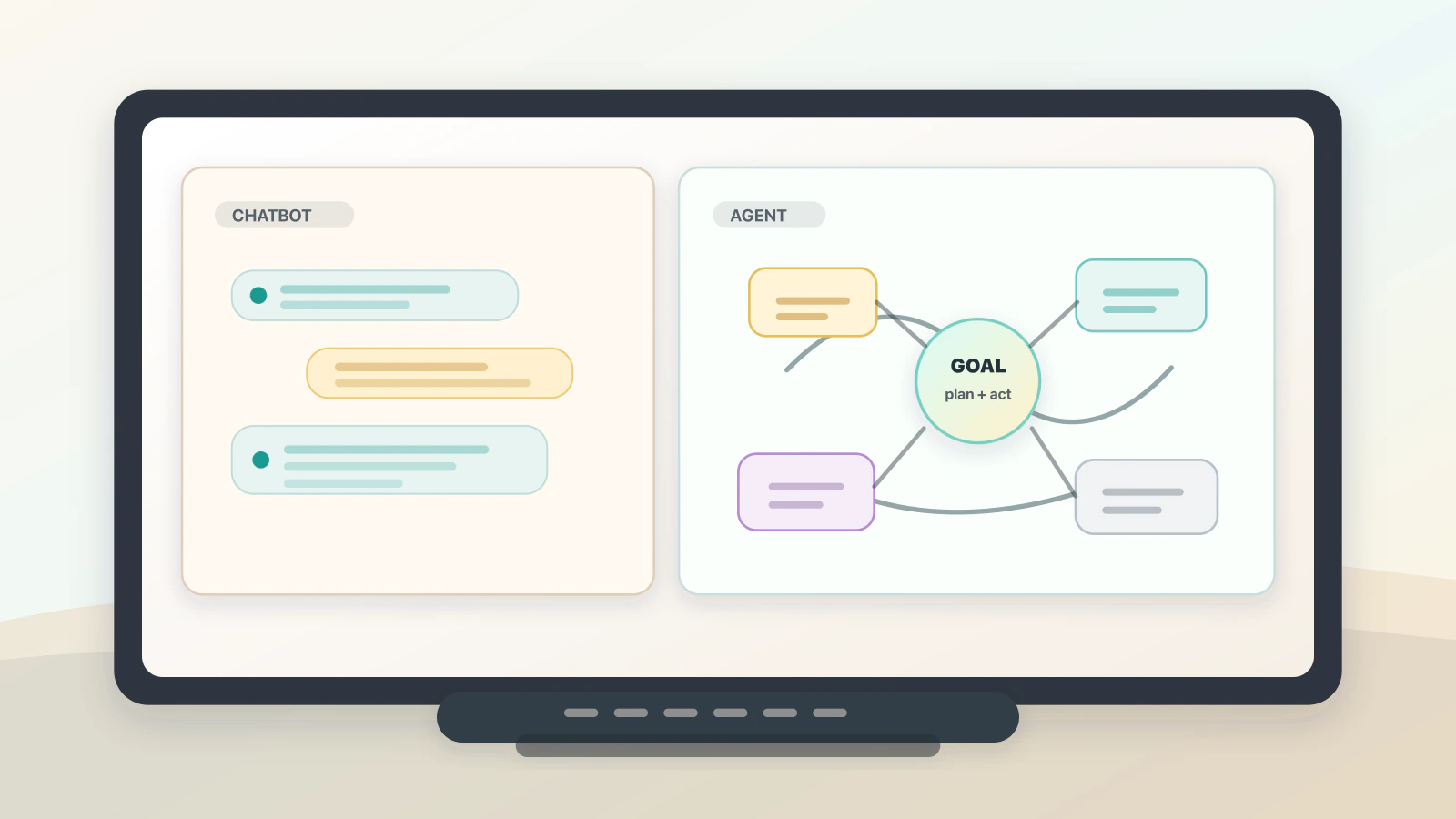
What's the difference between an agent and a chatbot?
A chatbot answers questions. An agent carries out tasks — looks things up, updates systems, drafts and schedules — within limits you set. Most businesses need something in between, scoped to one job.
Can it see everything in the business?
Access is limited to the information and actions agreed for the project. We check how permissions in your source systems can be respected and test different user roles before connecting sensitive information.
Will it make things up?
AI can produce incorrect or unsupported answers, even when using your documents. We test real questions, provide source references where appropriate and build in a handover or review step when answers need checking. Ongoing quality checks help identify gaps.
Which AI model does it use?
We compare models against the task, data-handling needs and budget. Changing models later may require integration updates and fresh testing, which can be planned as part of ongoing support.
How much does a custom AI agent cost?
Pricing depends on the task, information sources, software connections and testing required. We scope an initial assistant before quoting, including likely model usage and maintenance costs. Starting with one job keeps the first project easier to assess.
Is a custom agent better than a standard AI subscription?
Not always. A standard tool may be enough for drafting or general research. A custom assistant becomes useful when it needs controlled access to business information, connections to your systems or repeatable steps that a general chat tool does not provide.