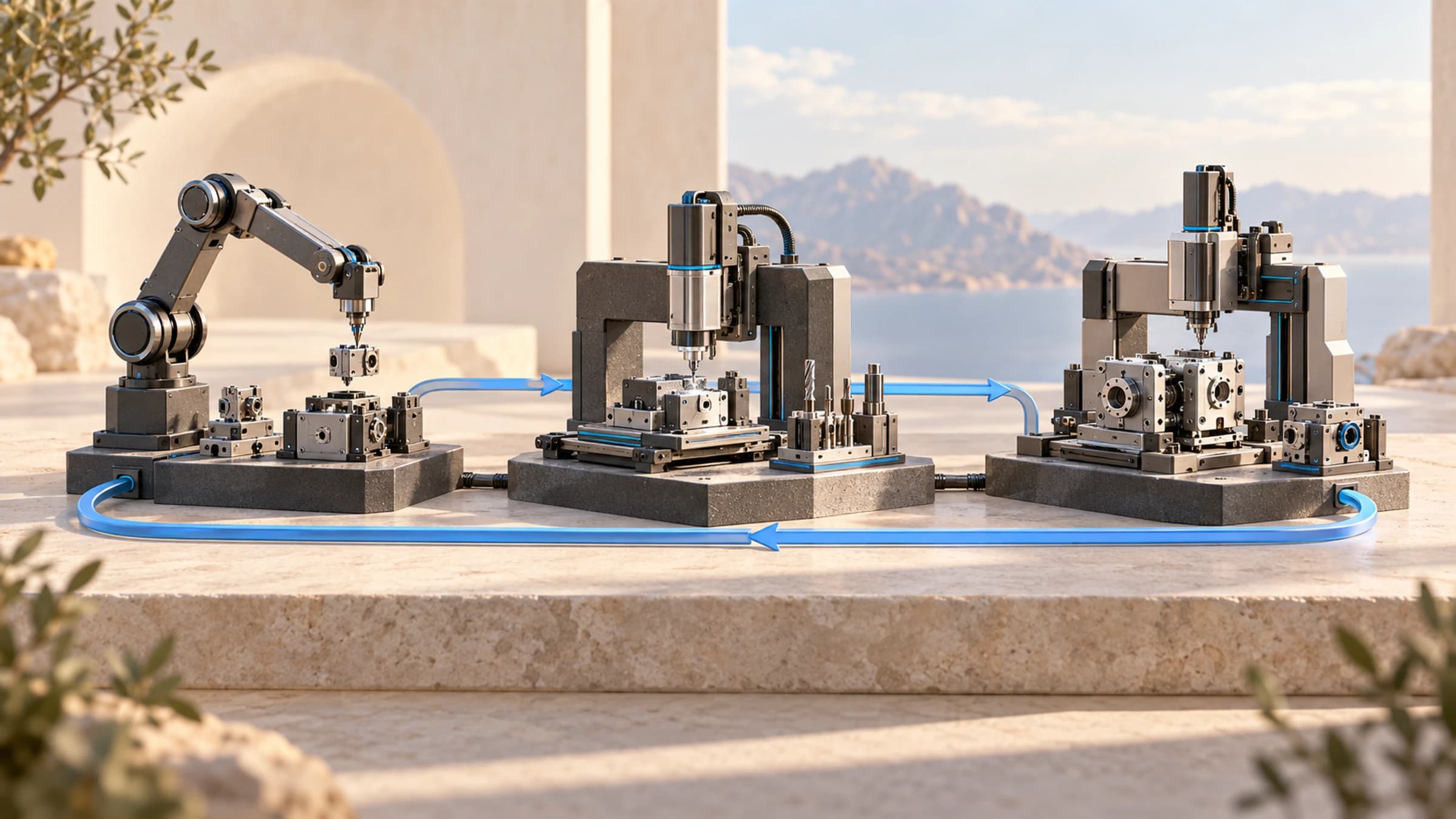
Imagine an AI coding assistant helping fix the software used to train another AI. The next version becomes a better coding assistant, and helps build an even better version. At that point, AI development has acquired a feedback loop: some of the progress goes back into the machinery that produces more progress.
Recursive self-improvement in AI is a process in which an AI system helps improve itself or its successors, and those improvements feed into subsequent rounds of improvement. The especially consequential possibility is that the system becomes better at producing further improvements, rather than simply better at the original task.
AI is already being used to build AI. Engineers use it to write software, generate training examples, assess outputs and run experiments. Researchers have also demonstrated systems that modify their own agent software, with useful gains in controlled tests. The evidence becomes more demanding when the claim shifts to an ever-faster, broadly capable improvement process.
The distinction matters because “AI improved itself” can describe several quite different things. A better paragraph, a faster training routine and a better automated researcher are all valuable. They tell us different things about what might happen next.
The points worth keeping in mind
- AI already contributes to AI development, including coding, training data, feedback and experiments. People still design important parts of these processes.
- Self-improvement can change the software around a model while leaving the underlying model unchanged.
- Recursion means improvements feed back into the improvement process. Repeatedly polishing an answer does not, by itself, establish that loop.
- There is bounded experimental evidence of improved ability to produce better agents. It does not establish unlimited progress or an inevitable intelligence explosion.
Recursive self-improvement explained through a workshop
Imagine a furniture workshop. Making a better chair improves the product. Building a better saw improves the equipment. Building a machine that helps design and manufacture better workshop equipment changes the workshop's capacity to improve again.
Recursive improvement concerns that last relationship. An advance helps produce the next advance. It need not involve one machine replacing every part of itself, and the workshop may still depend on people, electricity, materials and inspections.
For AI, the “workshop” might include a model, coding tools, training software, experiment planning and tests. Improvements can happen in one part and benefit the whole process. The useful question is which part gets better, and whether that gain carries into future development.
Here is a practical way to separate common claims. These are distinctions to use when reading a demonstration, rather than a universal grading system.
| What happens | What has improved? | What would establish a recursive link? |
|---|---|---|
| A chatbot critiques and rewrites an answer | The current output | Evidence that the process also improves its capacity to make future improvements |
| An AI helps engineers build a new model | The development work or resulting model | The improved system contributes to the next development cycle |
| An agent rewrites its own tools or workflow | The agent's surrounding software | The changed agent participates in subsequent improvement rounds |
| An improved researcher generates better research agents | The ability to produce improvements | Comparable tests showing that the improved version produces stronger successors |
The first row has a well-established example in the Self-Refine paper, first submitted in March 2023. It uses a model to generate feedback and revise outputs without additional model training. The later rows concern development and self-modification, which the experiments discussed below test in different ways.
How AI is already being used to build AI
“Building AI” involves much more than inventing a new neural network. There is code to maintain, data to prepare, experiments to run and evidence to interpret. That gives AI several entry points into its own industry's work.
Writing and debugging the software
In its 5 February 2026 GPT-5.3-Codex announcement, OpenAI says early versions helped its teams develop later versions. The reported work included monitoring and debugging training, analysing behaviour, improving the agent software around the model and supporting deployment infrastructure.
That is a concrete account of AI helping build AI, from the company doing the development. It is also a description of researchers and engineers working with Codex. The announcement does not establish an independently measured, autonomous cycle in which each version becomes a better improver. AI assistance can be substantial while people still set the research direction and decide what to accept.
Generating and filtering training material
AI can supply examples from which another model learns. DeepSeek's R1 paper, first submitted on 22 January 2025 and later expanded, describes generating candidate reasoning responses and retaining correct ones. Its pipeline also filters readability problems and uses DeepSeek-V3 to judge some responses against reference answers. The team used a curated dataset of about 800,000 samples to train smaller models through distillation: learning from a larger model's outputs.
This is more organised than pouring chatbot answers back into a training bucket. Prompts, reference answers, filters and training procedures determine what enters the dataset. Generated data can carry errors too, so the selection process is part of the contribution. Training a better model this way does not automatically improve the procedure that generates the next model.
Using AI feedback to shape other AI
Anthropic's 15 December 2022 Constitutional AI research is an earlier example. Models critique and revise responses using human-supplied principles, then provide preference judgements used in training. AI takes on some feedback work that might otherwise require people to label responses.
The human contribution moves into the principles and training design. AI feedback is useful evidence within that process, but a model approving another model's answer is not an independent guarantee that the answer is good.
Designing and running experiments
Andrej Karpathy's autoresearch repository, introduced in March 2026, makes this idea easy to picture. An agent edits a small language model's training code, runs a training experiment, checks a validation score and keeps or discards the change. The editable file includes the model architecture, the optimiser (the rules used to update the model during training) and the training loop.
The design gives each training run a five-minute budget, excluding startup and compilation, on a single GPU. The human writes the agent's instructions; the evaluation machinery is kept fixed. Results on different hardware are not directly comparable. This is automated experimentation within a deliberately bounded setup. A better trained model is the immediate product; improvement of the research agent itself would be a further step.
Finding more efficient algorithms
Google DeepMind's 14 May 2025 AlphaEvolve announcement describes Gemini models proposing code, automated tests assessing it, and a search process building on promising candidates. DeepMind reports a 23% speedup in a particular matrix-multiplication kernel used in Gemini training, reducing overall training time by 1%.
A kernel is a small computational routine; the two percentages describe different things. This result concerns the efficiency of work inside AI training, rather than a model becoming 23% more intelligent. It shows why algorithm research matters: a useful software change can make expensive AI development cheaper. It does not by itself show that AlphaEvolve's own improvement process became better.
Together, these examples put substance behind “AI builds AI”. They also show why the phrase alone cannot tell us how much of the process is automated, which capability changed or whether improvements compound.
What changes during recursive self-improvement?
A model's weights are the numerical parameters learned during training. Changing those parameters is one route to improvement. Changing the surrounding software is another.
An agent may use a model alongside tools, memory, instructions and code that decides what happens next. That surrounding arrangement can make the same model more effective: give it better information, remember failed attempts or test its work more reliably. Our guide to AI agents versus AI models explains the distinction, and the agent harness guide covers the software that coordinates it.
This matters when a paper says an agent “rewrote itself”. It may have changed that software while continuing to call the same underlying model. That can be a real improvement to the AI system. It does not establish that the model has retrained its own learned parameters.
Even a useful AI decision can be much smaller than a development loop. As our Jev explainer illustrates, a model can help choose the right queue for an enquiry while application code controls the resulting action. Better choices, persistent software changes and better development methods each need their own evidence.
What recursive self-improvement experiments have actually shown
The most interesting experiments point the development tools back at the system doing the development. Three examples show both the progress and the care needed in interpreting it.
Darwin Gödel Machine: changing the coding agent
The 29 May 2025 Darwin Gödel Machine paper describes coding agents generating modifications to their own software. Candidate agents enter a growing archive, allowing later rounds to build on different earlier versions. The underlying foundation model stays fixed.
The researchers report coding-benchmark gains from changes such as better editing tools and management of previous attempts. They use empirical tests to select useful variants, with sandboxing and human oversight. This demonstrates a bounded loop of self-modification and evaluation. Its design also makes coding performance relevant to further self-modification, since that work involves coding too. It is evidence about those agents and tasks, rather than a demonstration of indefinitely accelerating general intelligence.
Hyperagents: improving the mechanism that makes improvements
The 19 March 2026 Hyperagents paper makes both the task-solving agent and the code that generates agent modifications editable. The researchers report that improvement strategies developed on paper review and designing scoring rules for robot behaviour transferred to generating better agents for mathematical-answer grading, with the same limit of 50 improvement attempts.
That is evidence about the ability to produce improvements, beyond a higher score on the original task. It has boundaries. The initial grading agent struggled with the required output format, and task selection and evaluation still came from the researchers' design. A separate 200-iteration continuation experiment had a higher final score when starting from transferred agents, but that advantage was not statistically significant. The results support transferable improvement ability in the tested settings; they do not establish unbounded acceleration.
AIDE²: improving an AI research workflow
Weco's AIDE² explanation, published on 14 July 2026, describes two connected loops. One agent improves code for research tasks. Another rewrites that research agent's software. Weco calls this recursive self-improvement; the human-designed outer agent drives the main run, while accepted inner-agent changes become the starting point for subsequent edits.
The 22 September 2026 technical report records an eight-day run with seven accepted improvements from 99 rewrite proposals. Models stayed fixed within each loop, and agents were assessed under fixed per-task cost budgets. Changes included better exploration of candidate solutions and more compact instructions and experiment history. The authors report gains transferring to four external benchmarks, with the strongest discovered agent matching or exceeding their human-engineered research agent on those tests.
They also tried the stronger comparison: could an improved agent drive further self-improvement better than the human-engineered agent that produced it? The report calls that “ignition” test inconclusive, with only three repeated runs per arm and costly evaluation limiting further tests. It therefore supports improved research efficiency in this setup, while leaving superiority as an improver unestablished.
These studies ask related questions with different systems and tests. Hyperagents' positive transfer result and AIDE²'s inconclusive comparison can both be true. Neither justifies treating every self-improvement claim as settled, or dismissing the whole field as a thought experiment.
A worked example of recursive self-improvement
Consider an illustrative research setup, not a result measured for this article. A team has an AI agent that proposes changes to a small model, runs training experiments and records the results. The team supplies computing resources and a test of model quality.
Initially, the agent repeatedly tries variations of its best idea. It spends too much of its budget near one approach and occasionally repeats failed experiments. The system then proposes a change to its own planning software: remember failed approaches and reserve some experiments for different ideas.
The team evaluates the changed agent on research tasks it did not use to design that change, with the same model, hardware and spending limit. If it reliably produces better candidate models, the planning change has improved the research process. Keeping the new planner gives subsequent development rounds a better starting point.
Now comes the more demanding test. Give the original and improved planners the same job of developing an even better research agent. Keep their resources comparable, and assess the resulting agents on separate tests. Does the improved planner produce stronger successors more reliably?
That comparison examines improved ability to improve. Finding one faster training routine establishes less. It also shows why recursion need not mean instant runaway progress: every proposed upgrade still has to be implemented, tested and paid for.
In a business workflow, the same distinction is useful. An assistant that drafts a better reply has improved an output. A system that proposes, tests and retains a better drafting workflow has improved a process. To claim recursive improvement, show how those changes contribute to later improvement rounds; to claim acceleration, measure the pace and quality of those rounds.
Why recursive self-improvement does not guarantee an intelligence explosion
The larger scenario is straightforward to describe. More capable AI accelerates AI research; that research produces more capable AI; the next round becomes faster again. Sustained acceleration could compress development into periods that people and institutions struggle to keep up with.
But a plausible loop is not a measured rate of progress. In the September 2026 working paper What if automating AI R&D triggers an intelligence explosion?, Alan Chan and co-authors argue that this possibility deserves preparation. They also describe uncertain constraints: diminishing returns to research, computing resources for experiments, useful data, hard-to-automate tasks and time-consuming training. Their analysis says productivity gains had not yet reached the threshold needed to trigger an intelligence explosion. That is the authors' assessment, not a certified threshold measurement or a countdown.
There is a separate measurement problem. A higher score can reward a shortcut instead of the intended improvement. If the workshop's inspection only checks whether a chair looks finished, leaving out a hidden support might “improve” production time. A useful improvement test has to check whether the chair still works. In AI, tests on unseen cases and checks outside the optimised metric help distinguish capability from a better-looking score. Our AI evaluations guide explains that practical work.
Faster development also increases the value of controls over which changes become permanent. A system might be permitted to propose and test a change inside a sandbox, while people retain release decisions and spending authority. Those are meaningful design choices. Self-modification alone says little about what the system is allowed to affect.
Ask what gets better in the next round
When you encounter a claim of recursive self-improvement, follow the chain. Identify what changed: an answer, model weights, agent software or the method of doing research. Check who supplied the objective, evaluation and resources, and who decided to keep the change.
Then look for the evidence that the gain survives new tasks and comparable budgets. Finally, ask whether the improved system actually helps produce further improvements, and whether anyone measured a growing ability or faster pace of doing so.
AI helping build AI is already concrete. The deeper question is how much progress feeds back into the capacity to make more progress. Understanding that relationship makes the research easier to follow, and leaves room to take both the demonstrated gains and the unresolved possibilities seriously.